Donor thank you letter templates for Canadian charities
October 16, 2026
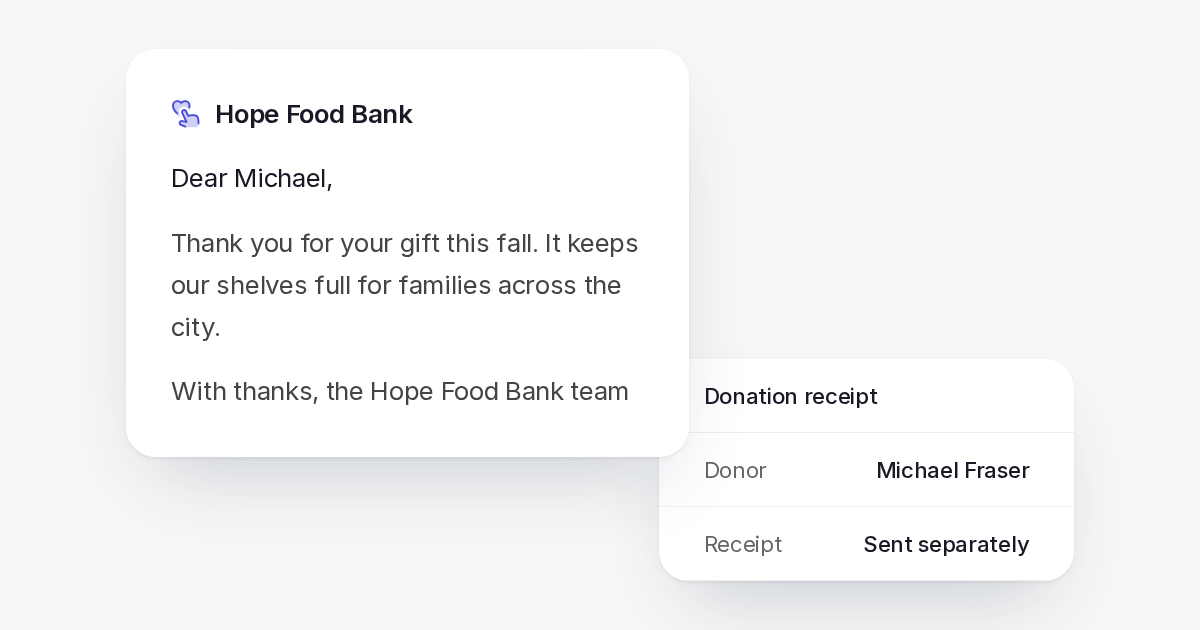
Write a donor thank you letter that feels personal. Use a template, plan your mailing and understand how a thank-you differs from a CRA donation receipt.
A donor thank you letter should acknowledge the gift, explain what it supports and tell the donor what to expect about their receipt. Start with the person who gave, then show how their support connects to your work.
Use an accurate name, a specific message and a clear reason for writing. The template below gives you a starting point you can adapt to your charity.
A donor thank you letter template
This is a sample template. Replace every bracketed field and remove any sentence that doesn't fit the gift.
Dear [donor name],
Thank you for your gift to [charity name] on [gift date].
Your support helps [describe the program or activity the gift supports]. Through this work, [explain the purpose in plain language, using facts your charity can support].
[If the gift is restricted to a particular purpose, acknowledge that purpose here.]
We're grateful that you've chosen to support this work. [Add a relevant, accurate detail about the donor's connection to the charity, or remove this sentence.]
[Choose the accurate receipt statement: Your official donation receipt is enclosed. / We'll send your official donation receipt separately by the method you've selected. / Please contact us if you have questions about receipting.]
If you'd like to ask about your gift or update your mailing details, you can reach [contact name] at [email or phone].
Thank you,
[signer's name]
[role]
[charity name]
Read the finished letter aloud. If it sounds like an appeal with a thank-you added at the start, give the acknowledgement more room and remove the request for another gift.
Make the acknowledgement specific to the donor
Use the name the donor provided, including their preferred form of address. Check whether the gift came from a person, a household or an organization before choosing the greeting.
Describe what the contribution supports. A restricted gift needs wording that reflects its purpose. For an unrestricted gift, explain the work the charity carries out without claiming that this particular contribution paid for a specific result.
Keep the difference between an activity and a result clear. You can describe a program your charity runs. You need evidence before saying a donor's contribution produced a particular outcome.
A donor acknowledgement letter can also recognize a relationship. Welcome someone making their first gift, or acknowledge continued support when your records confirm it. Avoid guessing how long someone has been involved.
For English and French correspondence, use the donor's recorded language preference where available. Prepare and review each version rather than leaving translated fragments in an otherwise English letter.
Get thank-yous ready while the gift is recent
Choose an internal schedule for acknowledgements and assign someone to review them. A regular review can keep thank-yous from waiting behind the next appeal.
Start with the gift records you already use. Check the donor name, gift date, preferred language and mailing address. Keep gifts that need clarification out of the mailing until the details are settled.
You can import a donor list and send donor thank-you letters by mail. Choose the donors you want to acknowledge, add the content you've prepared and review the recipients before submitting.
Use direct mail automation to schedule a mailing to a saved list or segment. Direct Mailer supports scheduled sends; it doesn't watch your donor database or send a letter automatically when a gift is recorded.
Choose your submission date with printing and postal time in mind. You can see when a letter is mailed and its estimated arrival. An estimated arrival doesn't promise the day a donor will receive it.
Keep the thank-you and official receipt clear
A personal acknowledgement and an official donation receipt serve different purposes. Don't present the sample above as an official receipt.
The CRA's receipting guidance explains the rules for issuing official donation receipts. Its required-information checklist covers:
- The statement that the receipt is for income tax purposes.
- The charity's registered name, address and registration number.
- A unique serial number, issue location and relevant gift and issue dates.
- The donor's full name and address.
- The gift amount, any advantage and the eligible amount.
- An authorized signature and the CRA's name and website address.
Non-cash gifts have additional requirements. Use the CRA's complete checklist when preparing a receipt rather than treating this summary as a receipt template.
Your charity prepares and issues its receipts. Direct Mailer can print and mail the PDF you provide. Make sure the receipt statement in your thank-you agrees with what you are sending.
Review the letter before mailing
Check the finished content against the gift record. Confirm that names, dates and any purpose attached to the gift are accurate. Test merge fields with the actual recipient data so blank values don't leave unfinished sentences.
Use the Canadian address format when preparing donor addresses. Review corrections and failed addresses before mailing. Formatting checks help catch errors; they don't confirm that a donor still lives at the address.
Respect your do-not-mail records. If an acknowledgement comes back, it returns to the address you provided. Mark it returned in Direct Mailer to record the return and exclude that contact from future list and segment mailings.
Keep a copy of the approved wording and note which donors were included. That record helps you answer a later question about what was sent without reconstructing the mailing from memory.
Questions about thanking donors
Can a donation thank-you be short?
Yes. A greeting, a direct thank-you and a specific explanation of what the gift supports may be enough. Include receipt information when relevant and give the donor a way to contact your charity.
For a short sample message, adapt: “Thank you for supporting [program]. Your gift helps us [accurate description of the activity]. We're grateful you've chosen to be part of this work.”
Should we mention the amount donated?
You can include it when it helps acknowledge the gift, provided it matches your records. A personal thank-you still needs to explain what the support means. Putting an amount into a letter doesn't turn it into an official donation receipt.
Who should sign the letter?
Choose someone whose role makes sense for the message and who can stand behind its contents. That may be a charity leader, a fundraiser or a program contact. Use a real name and a contact route your charity monitors.