Canadian address format for your letters and postcards
October 15, 2026
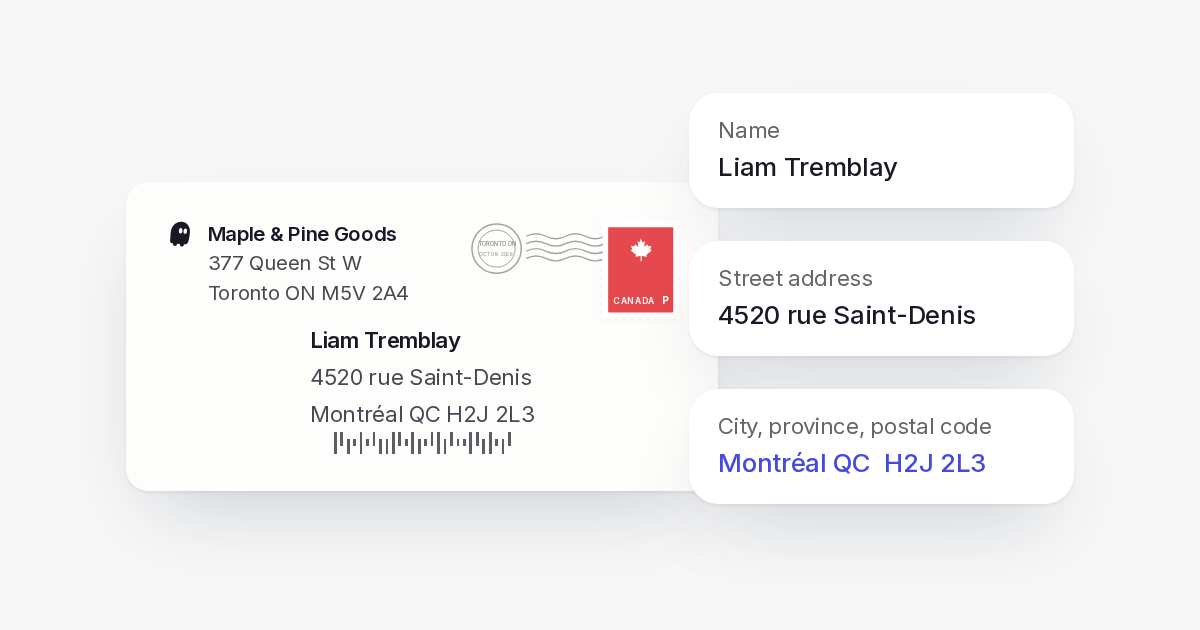
Canadian address format made clear with line order, apartment details, province codes and postal-code spacing. Check your mailing list before you print.
The Canadian address format puts the recipient’s name above the delivery address, followed by the municipality, province or territory, and postal code. Keep the unit number with the street information and use the recipient’s complete mailing details.
Start with the address the recipient gave you. Use the free Canadian address checker to review formatting before printing. A correctly formatted block helps you prepare mail, but it cannot establish that a person still lives at the address.
Put each address element in order
Canada Post’s Canadian addressing guide gives the standard civic-address order and variations for postal boxes and rural routes.
Use these patterns with the recipient’s real details.
| Address type | Line order |
|---|---|
| House | Recipient; civic number and street; municipality, province and postal code |
| Apartment | Recipient; unit and civic address; municipality, province and postal code |
| Postal box | Recipient; postal box and station; municipality, province and postal code |
| Rural route | Recipient; rural route and station; municipality, province and postal code |
If the address contains additional delivery information, keep it above the civic-address line. When both a civic address and a postal-box address are supplied, follow the postal-box arrangement in Canada Post’s guide.
Do not turn a rural-route or postal-box address into an invented street address to satisfy a form.
Keep the apartment number attached
For an apartment, Canada Post allows the unit number before the civic number with a hyphen between them. In that format, omit a separate apartment identifier.
This is a formatting example from Direct Mailer’s API documentation, rather than a customer record:
EMILY CARTER
204-1128 FORT ST
VICTORIA BC  V8V 3K8
Canada Post’s civic-address guidance also permits other unit placements. Include the unit when one is assigned; changing its position is different from leaving it out.
When combining customer fields, check that the unit does not disappear. A form may store it separately from the street, while a print file expects a complete address line.
For the other address types, retain the real identifier:
[RECIPIENT]
PO BOX [BOX NUMBER] STN [STATION]
[MUNICIPALITY] [PROVINCE]  [POSTAL CODE]
[RECIPIENT]
RR [ROUTE NUMBER] STN [STATION]
[MUNICIPALITY] [PROVINCE]  [POSTAL CODE]
The square-bracketed fields are placeholders to replace before sending.
Keep the block readable on an envelope
Use a clear, consistent font and keep the address block aligned to one left margin. Separate the return address from the destination address so the recipient and postal system can distinguish them.
Canada Post’s formatting guidance recommends uppercase, a postal code with a space in the middle, and the municipality, province and postal code on the last domestic line. If that line is too long, the postal code can appear on its own final line.
The guidance says lines should be under 40 characters excluding spaces and should not be truncated. Accents are permitted. A return address can sit at the top left or along the top on the back.
Leave enough space in the design for the complete address. Shrinking it into a decorative corner can make a clean contact record difficult to read when printed.
Use the official province and territory codes
Canada Post lists these postal abbreviations.
| Province or territory | Code |
|---|---|
| Alberta | AB |
| British Columbia | BC |
| Manitoba | MB |
| New Brunswick | NB |
| Newfoundland and Labrador | NL |
| Northwest Territories | NT |
| Nova Scotia | NS |
| Nunavut | NU |
| Ontario | ON |
| Prince Edward Island | PE |
| Quebec | QC |
| Saskatchewan | SK |
| Yukon | YT |
Use postal abbreviations consistently when preparing a list. Do not mix older abbreviations with the codes your mailing system expects.
Check the province against the rest of the address before correcting it. If the source data conflicts, ask for the right details rather than choosing whichever value makes the field pass.
Preserve French names and accents
Use the official street and municipality names. Do not translate a street name to make it look English.
French street types can appear in a different position from English ones. Follow the civic-address rules for the address supplied, including their treatment of ordinal street names.
Keep accents in your source data and check how they appear in the proof. A CSV import, merge field or font change should not silently replace a recipient’s name with broken characters.
Treat a postal-code pattern as one check
A Canadian postal code uses alternating letters and numbers, conventionally shown as A1A 1A1. Normalize case and spacing before evaluating the rest of the record.
A matching pattern alone cannot prove an address exists. Nor can it prove that the code belongs with the supplied street, municipality and recipient. Keep format validation separate from a claim about deliverability.
In an import workflow, retain the original address beside the corrected output where your system allows it. That makes it possible to review what changed rather than overwriting the evidence.
Review errors before you spend on the mailing
Common problems to review include a missing unit, incomplete delivery information, mismatched province details and fields placed on the wrong line.
You can check Canadian addresses before you print with Direct Mailer. Its checks apply Canada Post’s addressing rules and return verified, corrected or failed results. They are rules checks, rather than a live lookup confirming every physical destination.
Review failed records before approving the mailing. If a recipient provides a correction, update the contact so the next campaign starts with better information.
Keep formatting checks in your software workflow
The direct mail API checks an address when you create mail and returns the submitted and printed versions. Your application can present the correction and handle a rejected field before proceeding.
Keep unit, street, municipality, province and postal code as separate source fields where practical. Combine them when producing the address block, then inspect the result in test mode.
Avoid validating only with a postal-code expression. A complete workflow also needs required fields, supported country, province handling and a process for incomplete data.
Common address questions
What does “attention” mean in an address?
It identifies the person or department intended to receive mail within an organization. Keep the organization and delivery address intact; an attention line does not replace them.
Should I add Canada to a domestic address?
Canada Post’s guidance says to avoid the country name on domestic addresses. For international mail, follow the relevant country-line rules.
Will a corrected format guarantee delivery?
It improves the address block’s conformity with the rules. It does not establish that the recipient is current, the building exists or the mail was received.