Direct mail marketing in Canada for your next campaign
October 15, 2026
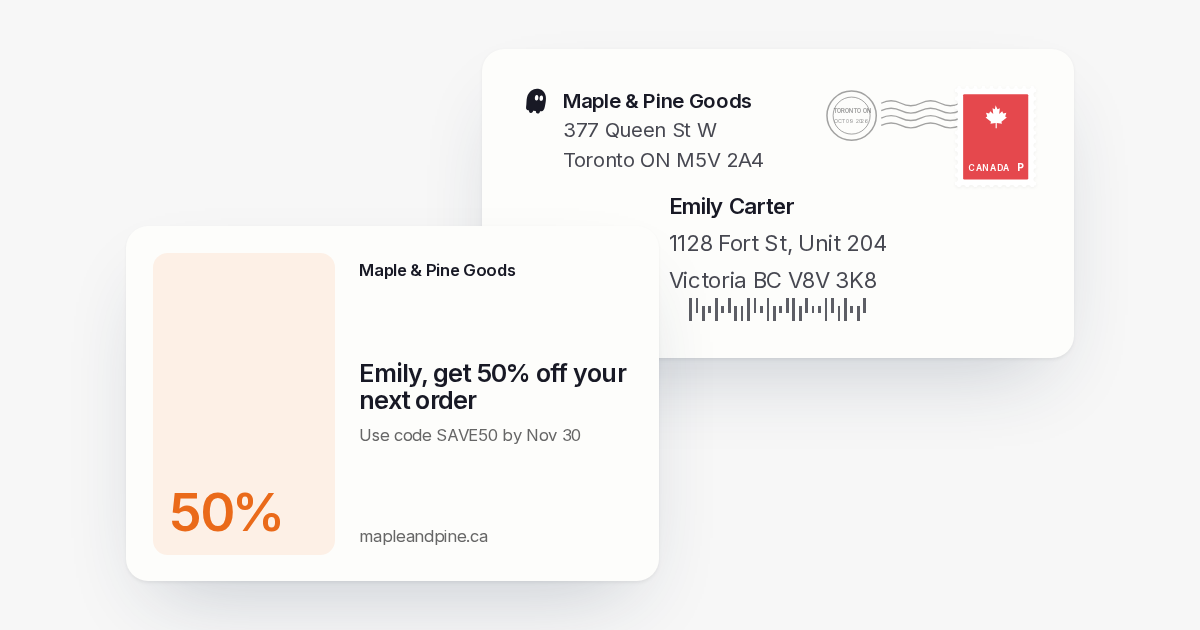
Direct mail marketing in Canada starts with your audience and offer. Plan the format, budget, address list, timing and measurement before your next send.
Direct mail marketing in Canada uses printed mail to put an offer, announcement or invitation in front of an audience. You can mail people on an address list or use Canada Post’s area-based advertising services to cover selected neighbourhoods.
Start with the customer action you want. A store opening needs a clear invitation. A win-back offer needs a reason to return. A useful campaign gives the reader enough information to act and gives your team a way to assess the result.
Our direct mail services cover addressed postcards and letters, printed in Canada and mailed with Canada Post. The planning steps below apply before you choose how to send.
Decide what success will mean
Write the audience, offer and desired response in plain language. “Previous customers book an appointment” is easier to plan around than a broad goal such as “build awareness.”
Choose the response you will count and the period you will measure. Decide who owns the result data before the campaign begins. If you need to establish incremental sales, plan a comparison group in your own data while you can still separate the audiences.
Canada Post’s February 2023 household research found that 87% of respondents glanced at or read every mail item and 62% collected mail at least three times a week. Those findings describe attention and collection behaviour. Your campaign still needs its own outcome measure.
Choose addressed or area-based mail
Use an addressed list when the message depends on who the customer is or what relationship they have with you. Previous customers, existing donors and tenants each need a different message.
Area-based mail can support a local awareness campaign when location defines the audience. Canada Post describes its options on its direct mail overview.
Check current availability and preparation requirements before booking a service. Direct Mailer sends addressed mail only and does not sell Neighbourhood Mail.
Choose a format that suits the message
A postcard puts a short message, image and next action on view. It can suit a store invitation, local listing or product reminder.
A letter gives you more room for an explanation. It may suit a donor thank-you, a notice or a message that needs an envelope.
Plan the copy before filling the available space. Keep the main offer clear, make the sender recognizable and tell the reader what to do. Include the conditions they need to judge the offer.
Put postage inside the complete budget
Compare finished mailing costs. Check whether printing, addressing and postage are included, and identify any separate design, data or subscription costs.
Choose the size and page count before approving the estimate. A change to either can change the job.
For a repeat campaign, retain the specifications and rate date alongside the budget. When you send again, check current rates rather than assuming the earlier estimate still applies.
Prepare the address list
Use contact information you are entitled to use for the campaign. Review duplicates, incomplete records and do-not-mail requests before sending.
Keep apartment or unit details with the street address. Confirm province codes and postal-code formatting. Formatting checks can identify rule errors, but they do not establish that a person still lives at an address.
Give someone responsibility for reviewing failed checks. A rejected row should prompt a correction or exclusion rather than be carried into the next campaign unnoticed.
Plan around the mailing date
Work back from the date the customer needs to act. Include time for preparing artwork, reviewing the audience, printing, mailing and estimated arrival.
Direct Mailer shows mailing statuses up to Mailed, meaning handed to Canada Post, plus an estimated arrival. Ordinary mail does not provide confirmation that a customer received or opened the message.
Use a sensible response window for the campaign. Avoid an offer that depends on every recipient receiving the card on a single exact day.
Connect the mail with your follow-up
Keep the offer and wording consistent across mail, your website and any permitted email follow-up. The customer should recognize the same campaign when they arrive online or speak to your team.
You can use mailing-status webhooks in your own systems to keep CRM records current or plan a next step. A Mailed event establishes the handoff to Canada Post. It does not prove delivery.
Check your email permissions separately when adding an electronic follow-up. A mailing address does not establish permission to send every other form of marketing.
Match the workflow to the team
Review direct mail use cases by industry to see how the planning changes with the message.
Use insurance direct mail for policyholder communication and relevant offers. With property management direct mail, you can send resident notices and owner outreach. For direct mail for agencies, agree who supplies the artwork, approves the audience and owns reporting.
Time-sensitive or legally required notices need their own review of content and service requirements. A marketing workflow should not be assumed to meet a statutory delivery obligation.
Choose a provider you can test
Check supported formats, Canadian mailing coverage, address checks, pricing inclusions and the evidence the provider gives you after sending.
If your software will send the mail, review the API and webhook workflow. If your team uses an AI assistant, confirm the exact supported client and the approval process.
Try test mode before using a live key. Review the design, corrected address and status changes, then resolve any errors while no physical mail is being produced.
Common planning questions
What is direct mail in advertising?
It is printed promotional material sent through the postal network to an address list or an eligible area-based audience.
What privacy considerations apply?
Review how you collected the personal information and the purpose for which you intend to use it. The Privacy Commissioner’s business guide explains responsibilities under Canadian federal privacy law. Provincial requirements may also apply.
How do I know whether to repeat the campaign?
Use the outcome you defined before launch. Compare actual mailing spend with response and contribution recorded in your own systems, and account for the measurement limits before increasing the budget.