Direct mail cost in Canada and how to budget a campaign
October 15, 2026
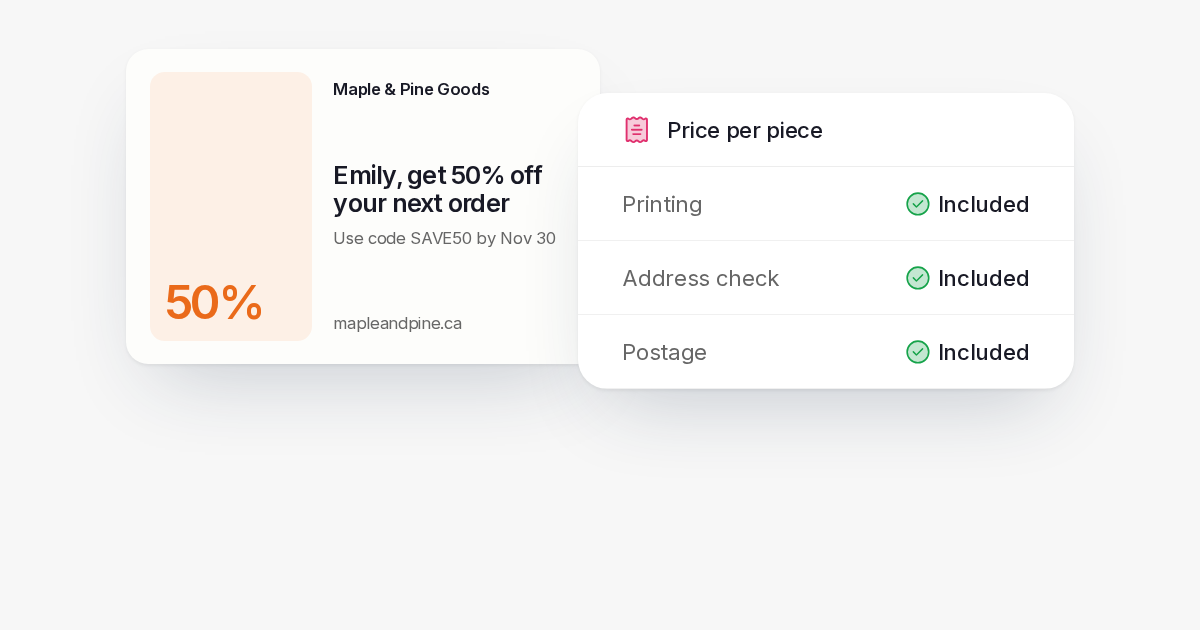
Direct mail cost in Canada includes printing, addressing and postage. Build a usable campaign budget, compare equivalent quotes and check current live rates.
Direct mail cost in Canada comes from printing, addressing and postage, plus any design or list work you need. Choose your format and mailing quantity, then compare complete quotes for the same campaign.
For a postcard campaign, separate production, addressing, postage and any design or list costs. For letters, include the envelope and the page count. This keeps a low print-only quote from becoming an expensive surprise once the mailing is ready.
Choose the mailing method first
An addressed campaign reaches people or businesses on your list. An unaddressed campaign covers selected delivery areas. They solve different audience problems, so compare the likely audience before comparing postage.
Canada Post publishes separate Personalized Mail and Neighbourhood Mail schedules, both effective March 23, 2026. Their categories and preparation requirements differ.
Use the Canada Post postage calculator to check your format and weight against the current data. Direct Mailer sends addressed mail only; Neighbourhood Mail is a separate Canada Post option.
A campaign to previous customers benefits from using your customer list. A local awareness campaign may need a different audience plan. A smaller postal charge does not establish which audience will be more valuable to your business.
Build an all-in budget
Give each cost a place before asking for approval.
| Budget item | What to include | Question to resolve |
|---|---|---|
| Design | Copy, artwork and any versions | Who supplies print-ready files? |
| Printing | Format, stock, colour and quantity | Does the quote match your final design? |
| Address preparation | Formatting, data cleanup and personalization | Who fixes rejected records? |
| Postage | Applicable service and specifications | Is this included or billed separately? |
| Preparation | Any envelope or mailing work | Is the quote ready to mail? |
| Measurement | Campaign records and result analysis | Who reports responses and sales? |
| Subscription | Any recurring plan cost | Does it fit your expected send volume? |
Avoid counting an included item twice. If the provider’s rate already covers printing, addressing and postage, those are components of that rate rather than separate additions.
Keep internal work visible too. A team member preparing envelopes or correcting a list is spending time even when there is no supplier invoice.
Compare quotes for the same campaign
Write a short specification and send the same version to each provider. Include destination country, mailing quantity, format, colour, page count where relevant, personalization and who supplies the files.
Then compare the inclusions. Stannp’s Canadian pricing page describes production, printing, postage and mailing as included in its item prices. Other quotes may describe a different scope. Check the current terms rather than assuming every “per-piece” figure buys the same work.
Direct Mailer’s postcards with printing and postage included use one all-in rate per format and plan. Prices are final. Pay as you go has no monthly fee; Subscribe and save has a monthly fee and lower per-piece rates.
Do not infer a market average from a small selection of advertised starting rates. A defensible comparison needs equivalent specifications, captured quotes and a date for each.
Work through a postcard budget
Begin with the mailing list you can actually use. Remove duplicates, respect do-not-mail requests and review failed address checks before setting the final recipient count.
Choose the card size, then obtain the applicable all-in rate. Multiply that rate by the final count. Add separately billed creative, list or subscription costs only where they apply.
For another campaign using the same artwork, the design work may already be complete. Keep that distinction in the budget so a repeat send is compared fairly with a first campaign.
Record the calculation as:
Campaign cost = mailing quantity × applicable all-in rate + separately billed campaign costs
Use the current rates in your calculation. An old invoice can help reconstruct what happened, but it should not become the assumed rate for a new send.
Work through a letter budget
Start with the completed letter and any additional pages. Page count affects the print job, while the finished envelope’s dimensions and total weight affect postage.
For Direct Mailer, a letter includes one sheet; extra sheets cost extra. Check the current supported page limit and rate before sending a longer document.
Decide whether the letter needs colour. A notice with text and a logo may have different requirements from a promotional letter with product photography. Choose based on the message, then compare equivalent quotes.
Keep your return address current. Returned mail comes back to the sender’s return address, and marking it returned helps prevent another send to the same contact.
Know what changes the price
Check whether your card is standard or oversize before finalizing artwork. A change in size can affect both printing and postage.
Weight can change when you add pages or choose a heavier material. Quantity can change the provider’s quote or the postal service’s eligibility. Colour, mailing destination and plan can also affect the final calculation.
A purchased list is a separate decision. Ask where the data came from, what use is permitted and how recently it was maintained. Buying names does not establish that they are suitable recipients for your offer.
Common cost questions
How much does it cost to mail a postcard in Canada?
Check the finished card’s size, weight and destination against the current postal schedule. For a managed campaign, use the provider’s current all-in rate for that format.
What is Admail?
The term appears in older Canadian advertising-mail material. Identify the current Canada Post service by its present name before applying any rate or preparation rule.
How do I budget for a larger campaign?
Use your final usable recipient count and the matching rate. Include fixed campaign costs separately, then calculate total cost and cost per recipient from the same scope.
How should I record the estimate?
Save the specifications, quote date, rate source, inclusions and assumptions. After the campaign, replace estimates with actual spend and record why the total changed.