Canada Post delivery time for letters and campaigns
October 15, 2026
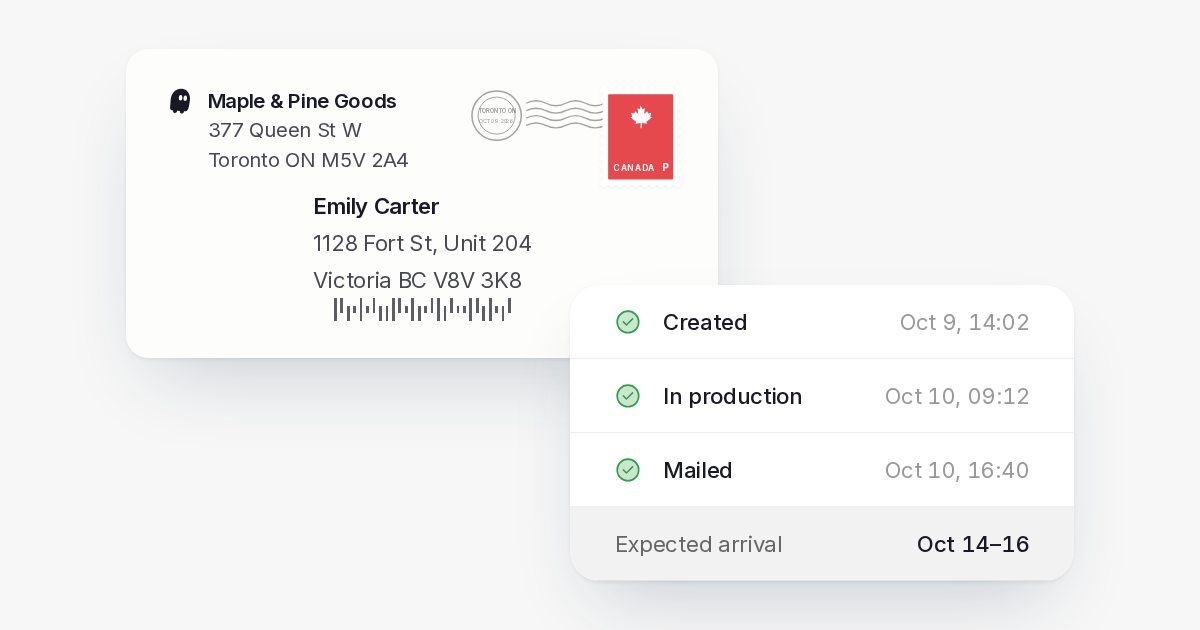
Canada Post delivery time depends on the service and route. Check published letter standards, allow for mailing preparation and plan follow-ups using estimates.
Canada Post delivery time depends on the service, origin and destination. Its published regular-letter standards are two business days locally, three within a province and four nationally, excluding the day of mailing. These are estimates, so plan your campaign with room before the offer or event deadline.
The date you submit a design is different from the date Canada Post receives the mail. Allow for reviewing the audience, preparing the artwork, printing and handing over the mailing before counting postal delivery time.
Use the regular-letter standards correctly
Canada Post’s Lettermail delivery standards give the following general estimates.
| Destination | Published standard |
|---|---|
| Local, within a city | Two business days |
| Within a province | Three business days |
| National | Four business days |
The day of mailing is excluded, and Canada Post states that these standards are not guaranteed. More specific routes and commercial deposits can require a closer check.
Keep the service name with the estimate. A parcel delivery standard should not be used to plan a postcard campaign simply because both travel through Canada Post.
Check commercial mail by service and route
Personalized Mail has its own standards. The applicable window depends on the mail category and processing facilities, with adjustments for some destinations.
Use Canada Post’s commercial delivery tables and the relevant origin and destination. Machineable standard mail, special handling and oversize categories have separate entries. Do not apply the regular-letter headline estimate to every commercial mailing.
Confirm which service your provider uses today. Direct Mailer currently sends postcards and letters as Lettermail.
Count business days from the handoff
Canada Post’s standards overview excludes weekends, statutory holidays and days it observes as holidays. Deposits made after the applicable collection or acceptance time count as the next business day.
For campaign planning, work with the date the mail was handed to Canada Post. If you only know the date the order was placed, you do not yet know how much of the postal window has elapsed.
Direct Mailer does not promise a print cut-off or fixed printing turnaround. Its status changes show the progress of the mailing. Use the Mailed date once it is available and treat the expected arrival as an estimate.
Leave room for address issues and disruption
An incomplete mailing list can delay preparation before the postal journey begins. Review missing unit details, province mismatches and malformed postal codes while you still have time to correct them.
Weather, operational disruption and holidays can also affect the schedule. Check Canada Post’s current service information when timing matters, particularly if you are mailing across several regions.
If the purpose is a required notice, confirm the applicable legal requirements before choosing the service and deadline. An estimated arrival does not establish proof of receipt or statutory compliance.
Community mailboxes change the collection setting
Canada Post’s April 2026 announcement described approximately four million door-to-door addresses moving to community mailboxes over about five years. Its June update added a further phase planned for 2027.
A conversion announcement does not establish that the postal journey will take longer. It changes where people collect their mail. Avoid promising that a customer will see an offer on the day it reaches their mailbox.
For an event invitation, leave a usable response period after the estimated arrival. That gives recipients time to collect, read and act on it.
Plan backwards from the customer’s deadline
Start with the last useful date for the recipient to respond. Then work backwards through each part of the campaign.
| Planning step | Decision to make |
|---|---|
| Customer response | How much time should the reader have to act? |
| Postal journey | Which service and route estimate applies? |
| Mailing handoff | When will the provider show Mailed? |
| Production | What review and preparation still need to happen? |
| Audience and design | Who approves the list and final artwork? |
Use this plan to identify deadlines your team controls. Confirm the audience early enough to resolve address errors, and approve the artwork before an offer becomes stale.
A scheduled send establishes when mail is eligible to proceed through production. It should not be presented as a guaranteed arrival booking.
Use mailing status to plan your follow-up
With Direct Mailer, you can track every piece up to Mailed and view its estimated arrival. Mailed means handed to Canada Post.
Use direct mail webhooks to update your own CRM or plan follow-up from that handoff. Allow for the estimated postal window before sending a message that refers to the card.
Ordinary mail has no recipient-level delivery event. Avoid a follow-up that says “your postcard arrived today” unless the customer has confirmed it.
Common delivery questions
What time will mail arrive at my address?
The standards above describe business-day windows, not a guaranteed hour. A campaign should not depend on a particular time of day.
Can I hold my mail while I’m away?
Canada Post offers Hold Mail online and at post offices, with eligibility rules and exclusions. Check the service directly before arranging a hold.
Does Mailed mean delivered?
It means the mailing was handed to Canada Post. Direct Mailer supplies an estimated arrival for ordinary mail, rather than confirmation of receipt.
How should I assess a late campaign?
Check the Mailed date, the service and route, holidays, address details and current operational information. Keep those facts with your campaign record before deciding what to change for the next send.