Neighbourhood Mail vs Personalized Mail for your campaign
October 15, 2026
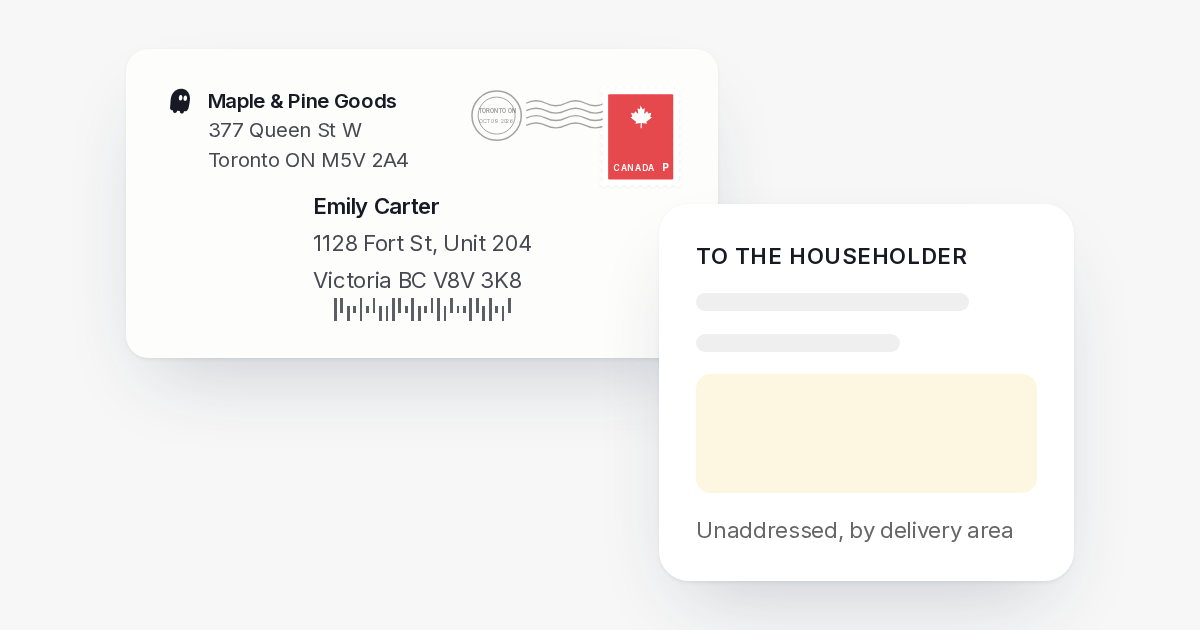
Neighbourhood Mail reaches selected delivery areas; Personalized Mail uses an address list. Compare audience, preparation, cost factors and service checks.
Neighbourhood Mail is Canada Post’s unaddressed advertising service for selected delivery areas, while Personalized Mail uses an address list for qualifying promotional messages. Choose between them based on who needs to receive the offer and how much you know about that audience.
A local opening may need broad awareness around a store. A customer win-back offer needs a list of people who have bought from you. Those are different audience decisions, even when both campaigns use postcards.
Direct Mailer sends addressed postcards and letters. It does not sell Neighbourhood Mail or Precision Targeter services.
Use delivery areas for local reach
Canada Post’s Neighbourhood Mail service lets businesses plan advertising around cities, neighbourhoods and postal areas, with targeting tools for refining the geography.
You do not need a named recipient list for every household in a selected area. You do need to understand what the selected coverage includes and which delivery points are eligible.
That can suit an offer whose relevance is largely geographic, such as an invitation to a nearby business. The campaign still needs a reason for residents to act. Geography alone does not establish interest in the product.
When planning coverage, check whether the area matches the people you can serve. A boundary that looks convenient on a map may include homes outside your service area or miss a nearby community.
Use an address list for customer relevance
Personalized Mail supports addressed promotional communication. Its audience can be selected from the customer information you are entitled to use.
A current customer, a lapsed buyer and a previous donor may need different messages. An address list lets you decide which people belong in the campaign and exclude those who should not receive it.
Keep service eligibility separate from personalization. Adding a name to artwork does not by itself establish that the mailing qualifies for a particular Canada Post commercial category.
Review the applicable content, format, preparation and volume rules with Canada Post or your mailing provider before choosing the service.
Compare what you need to supply
| Planning decision | Neighbourhood Mail | Personalized Mail |
|---|---|---|
| Audience basis | Selected delivery areas | Recipient address list |
| Customer data | Area selection rather than a named list | Records suitable for the intended campaign |
| Message | Relevant across the selected coverage | Can reflect the recipient relationship |
| Preparation | Service-specific route and production rules | Service-specific address and production rules |
| Measurement | Campaign response using your own records | Campaign response using your own records |
| Availability | Check current service notices | Check current service notices |
For either method, decide how you will count enquiries or sales before mailing. Neither service name tells you how much additional profit the campaign will produce.
Compare complete costs
Canada Post’s Neighbourhood Mail price sheet and Personalized Mail price sheet, effective March 23, 2026, distinguish categories by format, weight, handling or payment requirements.
Use the correct category and quantity when obtaining a quote. Include production and preparation, then compare the total against the audience you expect to reach.
For a managed addressed campaign, check addressed postcard pricing with printing, addressing and postage included. Direct Mailer’s current service should be assessed on its actual formats and inclusions, rather than assumed to use a particular Canada Post commercial agreement.
A lower cost per item does not automatically produce a lower cost per useful response. List relevance, the offer and the ability to serve the recipient affect the business case.
Keep the September 2025 disruption dated
On September 12, 2025, Canada Post announced that CUPW would begin a Neighbourhood Mail delivery ban on September 15. Canada Post stopped accepting that service’s items at that time. The announcement said addressed items were outside the scope of that action.
That notice describes the September 2025 situation. It cannot establish the availability of every service on a later date.
As reviewed on October 15, 2026, Canada Post publishes current Neighbourhood Mail product information and commercial schedules. Confirm current acceptance and disruption information directly before committing a campaign.
Avoid building a mailing plan around an undated claim that “flyers have stopped.” Save the operational notice and date that actually apply to your booking.
Choose the audience you can serve
Use a named address list when your message depends on customer history or an existing relationship. Check the list, identify exclusions and keep a record of the audience used for each send.
Use delivery-area planning when broad local coverage is the goal and the service is available for the campaign. Check the eligible points of call and preparation requirements before printing.
For real estate postcards, an addressed list can support relevant listing updates and local market information. Keep the geography manageable, confirm your rights to use the records and review brokerage advertising requirements.
If you need to compare the approaches, define the audience, offer and result measure before launching. A campaign covering different people cannot isolate the effect of the mailing method alone.
Common service questions
What is unaddressed Admail?
It is an older term associated with unaddressed advertising mail. Use the current Neighbourhood Mail name when checking Canada Post specifications and availability.
Is Precision Targeter a Direct Mailer feature?
No. It is a Canada Post planning service. Direct Mailer sends to recipient addresses supplied through its app, API or supported AI-assistant workflow.
Does mail always arrive at the door?
Delivery arrangements differ by address. Some recipients collect from community or building mailboxes. Confirm the relevant address and service details rather than assuming door delivery.
How should I budget for a campaign?
Choose the audience method first, specify the finished format and obtain a current quote with all inclusions identified. Keep that quote and its effective date with the campaign plan.